What does a first tool look like?
You carry knowledge other people can use: how you see a pattern, what you would ask, what you would suggest next. A tool lets a stranger sit with that for ten minutes, without you in the room.
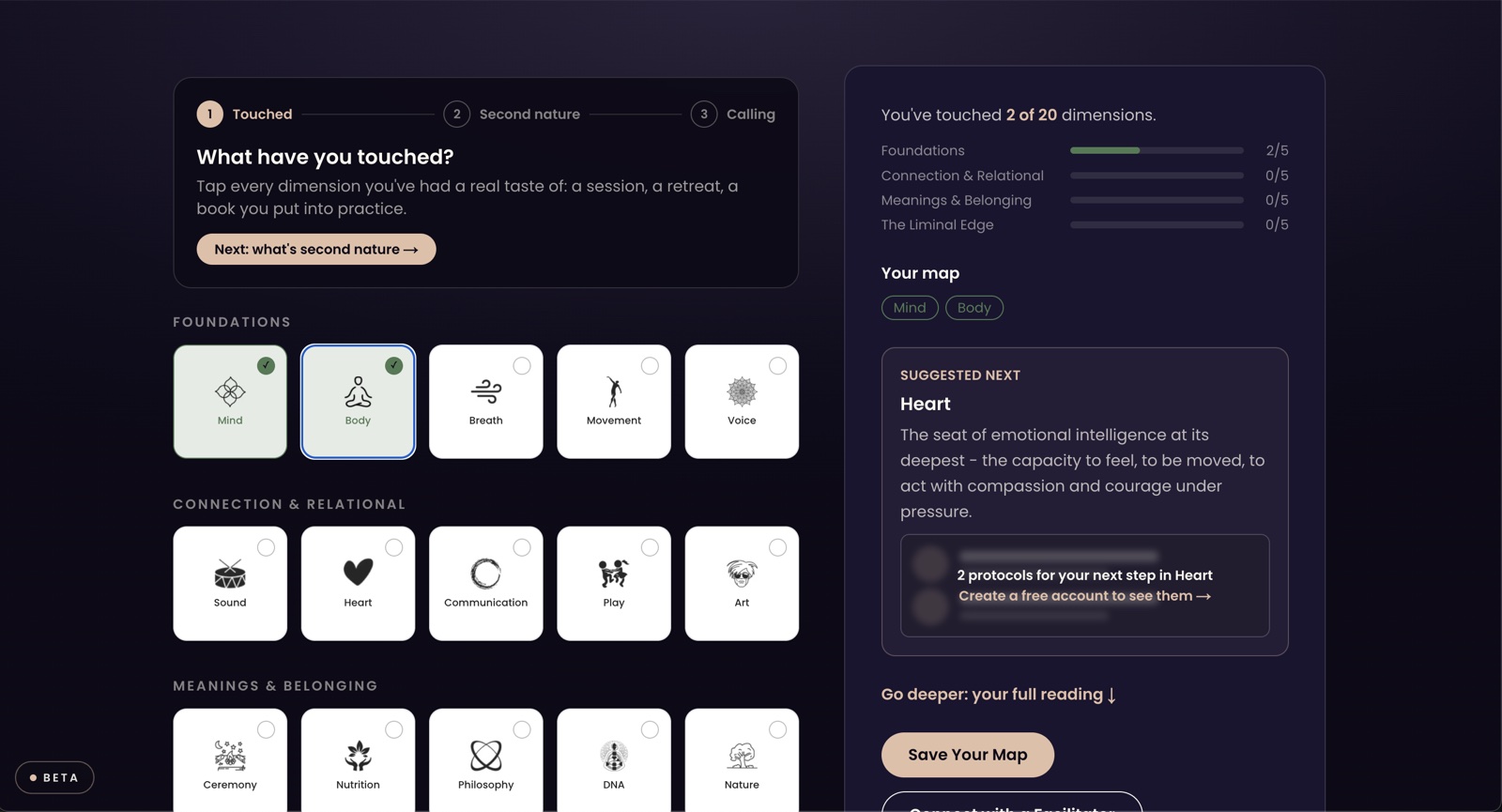
Here is a real first tool: Map Yourself on 21 Dimensions. A person taps the dimensions they have really tried, and the page shows where they are strong and where to look next. One job, one person, one result.
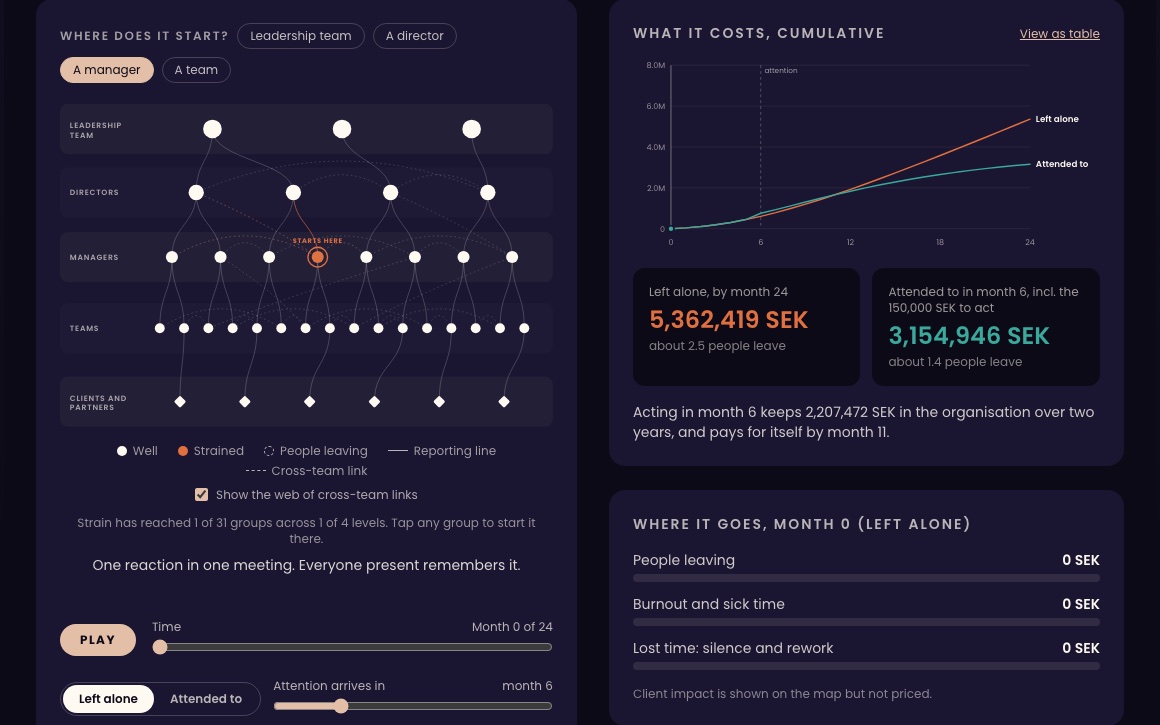
The same idea works for a very different job. The Ripple takes one leader's pattern and shows how it travels through an organisation, and what it costs with and without attention.
How do I find my first tool?
Do not start with the whole vision. Start with the question people keep asking you, and let your agent turn your own material into five small options.
I work with [kind of people]. They keep asking me [the question]. Below is how I answer it today: [paste a talk, a page of notes or a few emails]. Suggest five small web tools I could build from this. For each one: who it is for, what the person enters or picks, what they get back, and what it would look like on one screen. Then pick the one a stranger would understand in ten seconds, and say why.
Good answers have this shape. For Map Yourself: for someone curious about inner work; they pick the practices they have really tried; they get back their map and one suggested next step; it looks like a grid of tiles with a short summary beside it.
How do I turn what I know into rules?
Write it as a plain table: the things, what a person enters, what the page shows and what it suggests. Both tools above fit in one.
| Map Yourself | The Ripple | |
|---|---|---|
| The things | 20 dimensions in four families | Five levels of an organisation, from leadership to clients |
| What a person enters | The ones they have really tried | A scenario, where it starts and when attention arrives |
| What the page shows | Progress in each family and where they are strongest | How it spreads, and the cost with and without attention |
| What it suggests | One dimension to explore next | When acting pays for itself |
Keep the rules in one visible place, so you can read and change them without touching the screen.
Here is what I know about [topic]: [paste]. Put it in a table with four columns: the things a person can pick or enter, what the tool shows back, how it decides what to suggest, and what I am unsure about. Use only what I have given you and mark every gap as [question for me]. Do not add claims from elsewhere.
How do I keep the numbers honest?
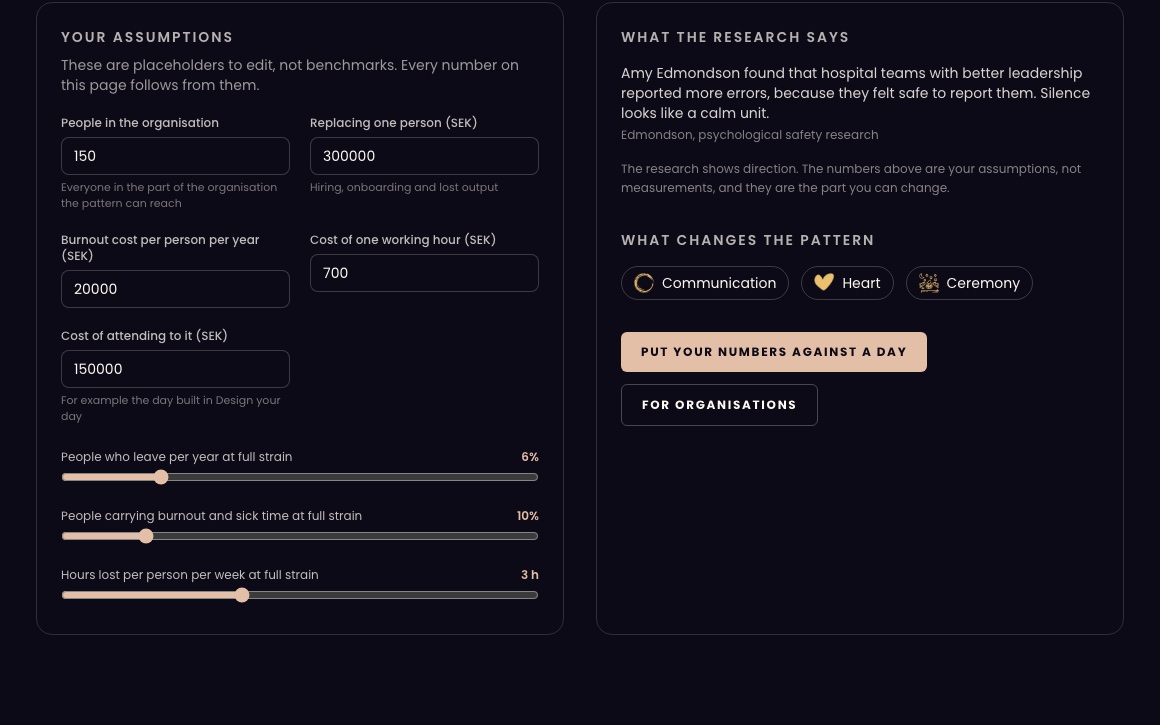
If your tool shows a number, a score or a cost, put the assumptions next to it, let people change them, and say what they are: placeholders, not measurements. It builds trust, and it keeps you out of claims you cannot back up.
Add a panel called “Your assumptions” next to the result. Every number on the page must follow from the values in it. Give each value a plain label, a sensible placeholder and one line of help. Say clearly that they are placeholders to edit, not benchmarks, and show where each number comes from.
How do I build it, and in what order?
Build a one-page web tool. The promise in one sentence: [what a person leaves with]. The person enters or picks: [list]. The page shows: [the result]. Use only this material: [paste]. Keep all rules in one table at the top of the code that I can read and edit. No accounts and no database. Style it in my brand: [colours, fonts, a page I like]. Show me a version I can click through today.
Write a ten-minute test script for five people trying my tool for the first time: what to say at the start, what to ask them to do, what to watch for, and three questions for the end. Remind me not to explain anything while they try.
The pieces have their own guides: an assessment or a map, get paid with Stripe, email automations.
Which sources can I use?
- Your own material: keynotes, books, notes, recordings. It is yours to use, and it makes the tool unlike anyone else's.
- Openly licensed sources: check the licence. Some ask for credit, some forbid commercial use, some require you to share what you build on them.
- Software and data from others: the same, and check names too, since some are trademarked.
- A person's own words: only what they choose to enter.
For each source I plan to use in the tool [list], tell me: the licence, what it requires (credit, commercial use, sharing what I build, trademarks) and whether I can use it as I plan. Say where you are unsure and what I should check with the owner or a lawyer. Do not assume permission.
What should I be careful about?
- Claims. Present what a model or tradition says as what it says: “in this system, ...”. Do not state its claims as fact, and do not promise health effects.
- Call the result a reflection, not advice or a diagnosis, and say so on the page.
- Personal data. Things like a date, time and place of birth are personal data. Keep them in the person's browser unless you need them, and tell people what you do with them.
- Respect for the sources. Give credit, and ask the people whose work you build on.
Read what the Swedish data protection authority says, and ask a professional if you are unsure. This is not legal advice.
What becomes possible?
A tool built from your own knowledge is something nobody can copy by reading your website.
- A grid where people tap what applies to them and see their own picture, like Map Yourself.
- A simulator that makes a hidden pattern visible and puts numbers on it, like The Ripple.
- A personal page that saves a person's result and suggests a step for each day.
- A course or a session that follows from the result: the tool is the front door.
From what I know and the material I have: suggest three digital tools I could build, each for one kind of person and one job. For each: what they enter, what they get back, which of my material it needs and the smallest version I could test with five people this week. Flag any licence or claims risk.
Questions people ask
What is the difference between a tool and a platform?
A tool does one job. A platform bundles several tools with accounts and content. Build the tool first.
Can I use an open source library or open data?
Often yes, but read the licence first. Some require credit, some restrict commercial use, some require you to share your own code.
Sources

Who is writing this
I am Nathaniel, a commercial operator. For twenty years, across four continents and more than fifteen ventures, I have taken research and young companies from idea to customer. Two KTH spin-offs reached joint development agreements with Fortune 500 partners. An indoor farm sold its full production within about ninety days and ended in a joint venture exit. This year I am a commercial expert for the European Innovation Council's Tech to Market programme. Now I build agents, because the hard part of new technology is rarely the technology. It is getting people to want it and use it.
Want to do this together?
In two hours I can build this with you: A digital tool or platform.