What should a proposal contain?
The meeting went well. You promised a proposal “this week”. You sit down on Thursday with a blank document and a vague memory of what she said. The first hour goes on remembering. A page of notes and a template would have cut that to ten minutes.
- The situation in the client's own words. It shows you listened.
- What you propose, in a short text.
- What is included and what is not.
- Timing, in phases if it is larger.
- Price. A fixed price per phase with a cap is clearer than an hourly rate, and gives both of you a chance to review between phases.
- One next step, and how long the proposal is valid.
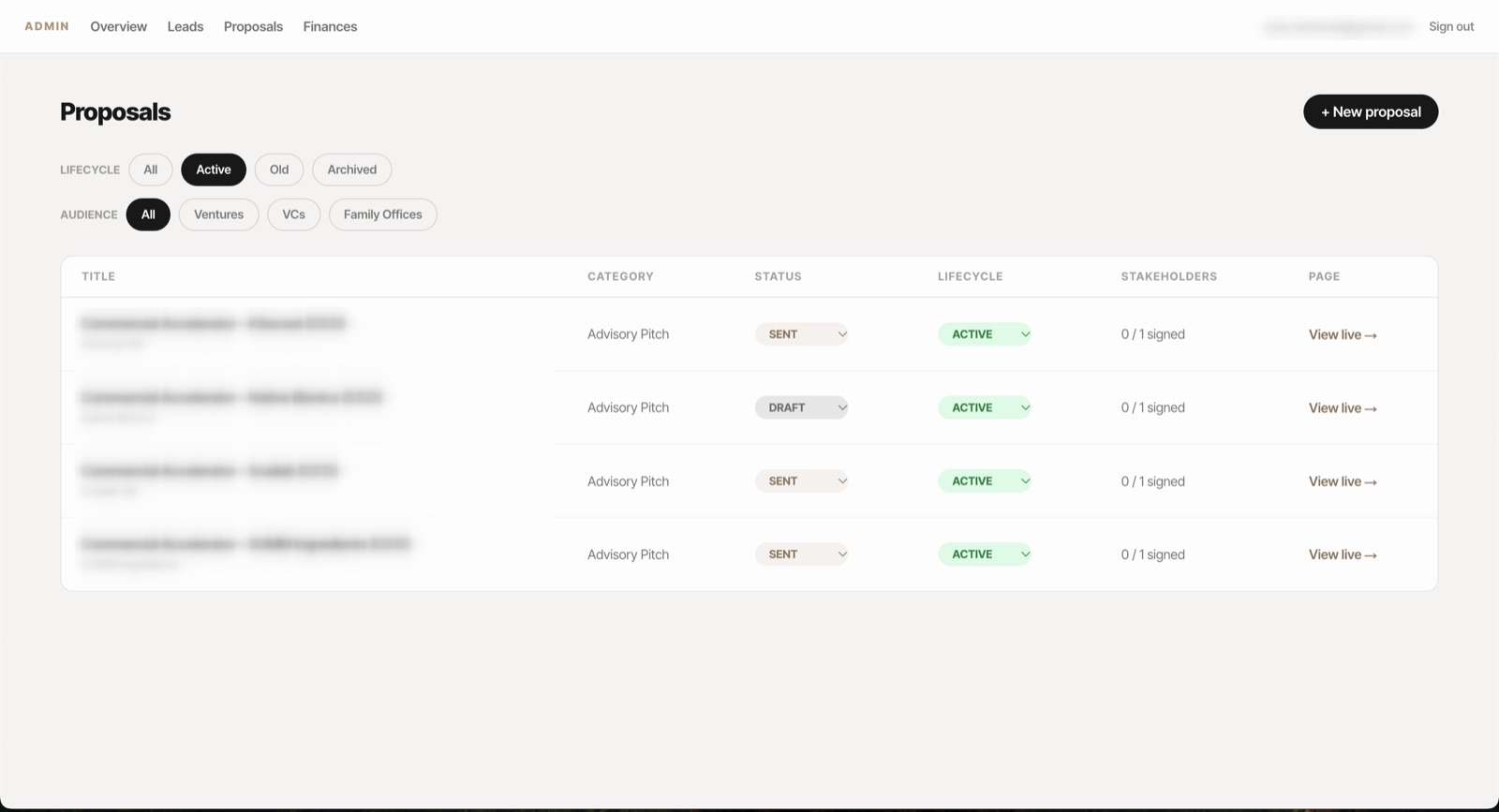
How do I make the template, and how does the agent fill it in?
Proposal builder
Set your phases and prices. Get the outline with a fixed price per phase.
# Proposal

## Your situation
[in the client's own words]

## What I propose
[short text]

## What is included
[list]

## What is not included
[list]

## Phases and price
1. Start: 12,000 SEK
2. Build: 24,000 SEK
Total: 36,000 SEK excl. VAT. After each phase we review and either continue, change or stop.

## Next step
[one step] Valid until [date].
Fill in the proposal template for [client] from the notes in the client list and [meeting notes]. Write “Your situation” in their own words where you can. Do not guess prices or dates: mark them [question for me]. Write nothing that is not supported by the notes.
What do I check before I send?
- Names, company, dates and amounts, word by word.
- That what is included matches what you discussed.
- That nothing the client told you in confidence appears.
- That the price is the one you want to stand behind, with or without VAT, clearly written.
- That it sounds like you. Read it aloud.
Always send it yourself. The agent writes the draft, you own the words.
What becomes possible?
A proposal does not have to be a document. It can be a page the client makes choices on.
- An interactive proposal where the client picks a package and sees the price change.
- A timeline that shows the phases and what happens when.
- A calculator for what the work pays back, with the client's own numbers.
- A page the client can share with their manager.
Turn my latest proposal [file] into a page where the client can choose between three packages, see the price update, open each phase for details and download a PDF. Keep every figure exactly as in the original and mark what is an estimate.
Questions people ask
PDF or link?
Both work. A PDF is easy to save. A link can be changed afterwards, but then the client needs to know which version applies.
How do I set a price?
Start from what the work is worth to the client and from your own time. Split larger work into phases with a fixed price and a chance to stop after each.

Who is writing this
I am Nathaniel, a commercial operator. For twenty years, across four continents and more than fifteen ventures, I have taken research and young companies from idea to customer. Two KTH spin-offs reached joint development agreements with Fortune 500 partners. An indoor farm sold its full production within about ninety days and ended in a joint venture exit. This year I am a commercial expert for the European Innovation Council's Tech to Market programme. Now I build agents, because the hard part of new technology is rarely the technology. It is getting people to want it and use it.
Want to do this together?
In two hours I can build this with you: Proposal template.