Why build a map instead of writing an article?
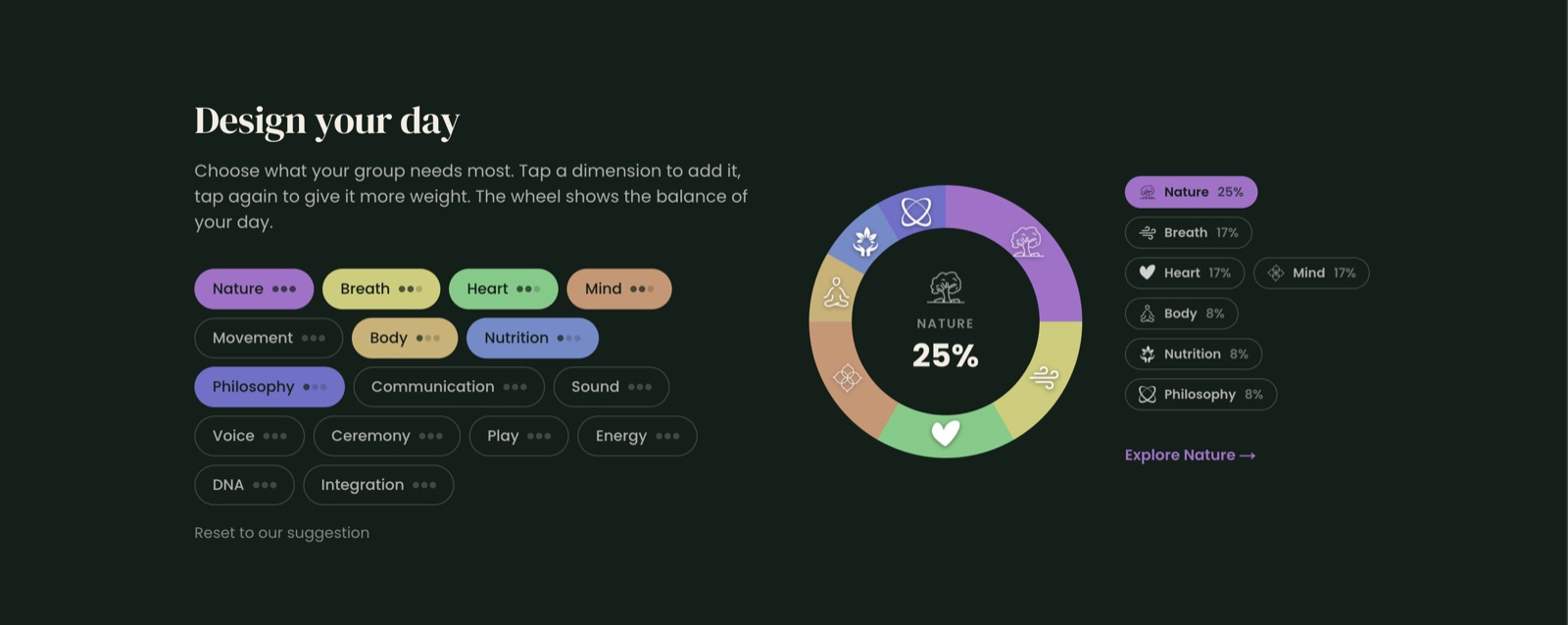
Someone reads your article and nods. Someone else answers ten questions about themselves and sees a shape appear on the screen: here I am strong, here I am thin. The second person remembers it, and writes to you.
People are interested in themselves. A tool turns your knowledge into a mirror. I built Map Yourself for 21 Dimensions in this way: people find where they are across the dimensions and which practices fit.
How do I design the dimensions and questions?
- Three to eight dimensions. Fewer than three is not a map and more than eight cannot be read at a glance.
- Each dimension should be something a person can recognise in themselves, in plain words.
- Three statements per dimension, rated one to five. “I notice when my breathing is shallow.” Write statements about behaviour, not about worth.
- A short note for low, middle and high, and one small practice to try.
Be honest about what it is. A reflection tool helps someone think. It is not a test and it does not diagnose. Say so on the page.
Try the map
Name your own dimensions and move the scores to see the shape people will see. The instruction under it builds the whole tool.
Try the map
Name your dimensions. Move the scores. See the shape people will see.
Build an assessment tool called "Body / Breath / Voice / Nature / Rest map". Dimensions: Body, Breath, Voice, Nature, Rest. For each dimension write three statements the person rates from 1 to 5. Score each dimension as the average. Show the result as a map (a radar or a ring) with the person's own scores, and under it, for each dimension, one short sentence for low, middle and high, and one small practice to try. Make it work on a phone, keep the answers only in the browser unless I say otherwise, and let the person copy or download their result. Use BRAND.md. Do not claim it measures anything medical or scientific: call it a reflection tool. Show me the questions first.
Can I map an existing framework?
Yes, and it is a good way to make something complex easy to explore. I built an interactive map of the Inner Development Goals framework on the Agentverkstad site, so people can click through the five dimensions and their skills. If you build on someone else's framework, keep its names and order unchanged, give credit as their licence asks and do not suggest an official partnership.
What should I do about people's answers?
- Keep answers in the browser by default. Nothing is sent anywhere unless the person chooses to share.
- Let people copy or download their result.
- If you want to follow up, ask clearly, with one button, and say what you will do with it.
- Answers about health or beliefs are sensitive. Think twice before storing them.
What becomes possible?
One map can carry a whole practice: an entry point, a course and a community.
- A map that recommends practices or a path based on the result.
- A team version where a group sees its combined shape.
- A tool that changes over time: take it again in three months and see what moved.
- A map for your own field that nobody else has.
From what I teach: suggest three assessment or mapping tools people would enjoy and share. For each: the dimensions, an example statement, what the result map looks like and what it leads to next. Pick the one that is quickest to build and sketch the questions.
Questions people ask
Is it a test?
No. Call it a reflection tool and say so. It helps people think, it does not measure or diagnose.
How many questions are right?
Fifteen to twenty-five is enough for a map. More and people drop out.
Sources

Who is writing this
I am Nathaniel, a commercial operator. For twenty years, across four continents and more than fifteen ventures, I have taken research and young companies from idea to customer. Two KTH spin-offs reached joint development agreements with Fortune 500 partners. An indoor farm sold its full production within about ninety days and ended in a joint venture exit. This year I am a commercial expert for the European Innovation Council's Tech to Market programme. Now I build agents, because the hard part of new technology is rarely the technology. It is getting people to want it and use it.
Want to do this together?
In two hours I can build this with you: An assessment or a map.